
Last updated:
New Orleans Concrete Leveling connects property owners with independent local contractors who fill voids under concrete slabs in New Orleans — the washed-out spaces under driveways, patios, walks and slab floors — by injecting material until the slab is fully supported again. Void filling is priced by the volume of material it takes, which isn't known until the void is probed. As a reference, HomeGuide lists mudjacking at $4–$9 per square foot and polyurethane foam at $8–$25, with a $300–$700 minimum.
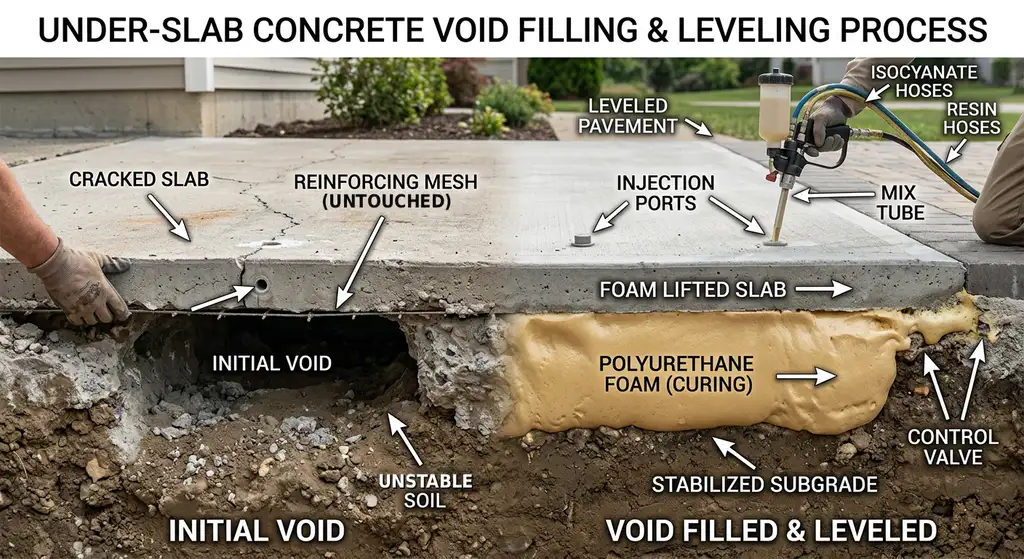
A void is what comes before a sunken slab. Water finds a path under the edge — a downspout, a leaking pipe, runoff from a yard — and carries fine soil away. The slab bridges the gap for a while. Then it cracks across the unsupported span, or the edge drops. Fill the void first and you often avoid both.
What happens on the first visit
Voids are found by sound, sight and probing. Expect the contractor to:
- Tap the slab to map hollow-sounding areas.
- Look at the edges for visible gaps, soil washing out, or erosion channels.
- Trace the water source — downspouts, grade, a leaking line, or pool plumbing.
- Probe through a test hole where needed to gauge void depth.
- Recommend the fill and the water fix, with a written price.
Where voids form in New Orleans
The usual suspects are downspouts that empty against a slab edge, driveways and walks where yard runoff crosses at the same low spot, slabs over a leaking water or sewer line, and pool decks over leaking returns. New Orleans' rainfall — more than 60 inches a year per the National Weather Service — means there's plenty of water to do the work.
The ground itself contributes. The City of New Orleans lists ruptured water and sewer lines among the effects of subsidence, and a broken line under a slab is a void-maker.
Filling vs lifting
If the slab hasn't moved yet, the job is simply to fill the space and stop the water. If it has dropped, the same injection that fills the void can lift it back — then it becomes a driveway, patio or sidewalk leveling job. Filling early is cheaper because less material goes in and the slab hasn't cracked.
Mudjacking slurry is economical for large, open voids. Polyurethane foam expands to fill irregular spaces, resists water once cured and adds little weight. For soft soil below the void, see soil stabilization.
Stop the water or the void comes back
Filling a void without fixing the water that made it only buys time. Extend or redirect downspouts at least a few feet from the slab, regrade soil so it falls away from the edge, seal the joints so surface water can't enter, and have a plumber test any line you suspect. The will my slab sink again? guide covers the causes of repeat settling.
How void filling is priced
Because the price follows the amount of material, contractors quote void filling after probing — sometimes with a per-unit rate for material beyond an estimated quantity. Ask how overruns are handled before work starts. Most contractors carry a $300–$700 minimum.
If a covered event such as a burst pipe caused the washout, ask your insurer; settling from ordinary drainage is generally excluded. See does insurance cover concrete leveling?
What a proper void filling job includes
- Hollow areas mapped by sound and probing
- Water source traced and explained
- Written price with material-overrun terms
- Fill injected until the void is closed
- Slab watched so it isn't over-lifted
- Holes patched with cement grout
- Edges and joints sealed against water
- Downspout and drainage advice
DIY patch vs cheapest operator vs proper void filling
| Factor | DIY patch or topping | Cheapest operator | Proper leveling job |
|---|---|---|---|
| Fixes the void under the slab | No | Sometimes | Yes |
| Actually raises the slab | No | Yes | Yes |
| Drop measured at every joint first | No | No | Yes |
| Method chosen for your soil | n/a | Whatever rig they own | Yes |
| Written price before drilling | n/a | Rarely | Yes |
| Holes patched, joints sealed | n/a | Holes only | Yes |
| Drainage cause addressed | No | No | Yes |
| Carries liability insurance | n/a | Ask | Ask — and verify |
| Typical life | Cracks as the slab keeps moving | Short if the cause isn’t fixed | 5–10+ years (mudjacking) |
| Typical cost, 150 sq ft patio | Materials only | Lowest bid | $600–$1,400 slurry · ~$1,200–$3,750 foam |
Proper-job cost and life from HomeGuide's mudjacking cost data; foam range calculated at HomeGuide's $8–$25/sq ft. Resurfacers and self-leveling toppings cover the surface; they don't lift the slab.