
Last updated:
New Orleans Concrete Leveling connects New Orleans property owners with independent local contractors who lift sunken sidewalk sections back to grade by injecting material underneath — no jackhammer, no new pour. With mudjacking, sidewalk leveling in New Orleans typically costs $400–$900 for about 100 square feet of walk, according to HomeGuide's mudjacking cost data. That's usually 30–50% less than tearing the squares out and repouring them. Polyurethane foam runs $8–$25 per square foot — about $800–$2,500 for the same 100 square feet.
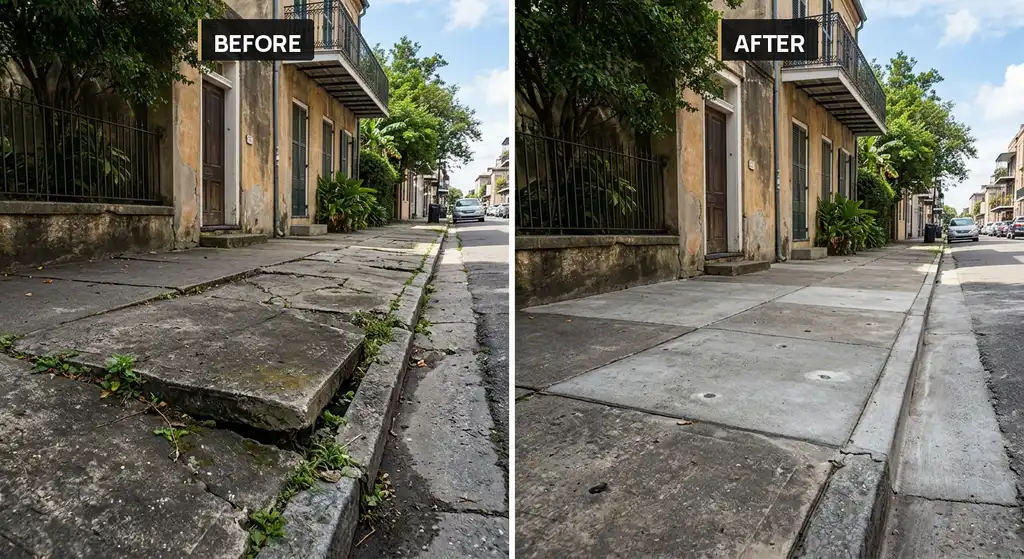
Sidewalks here fail in a recognizable way. One square drops while the next holds, and the edge between them becomes a lip that catches a toe, a stroller wheel or a delivery dolly. And in New Orleans, the walk in front of your lot is legally your responsibility. The City states that keeping a sidewalk "free from hazardous conditions is the responsibility of the residential or commercial property owner".
What happens on the first visit
A sidewalk estimate usually takes well under an hour. A contractor who knows the work checks:
- The height of every lip, measured at the worst point. A difference of a quarter inch is a nuisance; half an inch or more is a real trip hazard.
- Whether the square sank or was pushed up. Leveling only raises concrete. A square lifted by a live oak root needs grinding or replacement, not injection.
- Voids under the squares, usually where water runs off a roof, a driveway or a lawn onto the walk edge.
- Whether the walk is in the public right-of-way. If it is, the City's Sidewalk Repair Permit applies — more on that below.
- Method and a written price, covering every square that needs lifting, so you pay the minimum charge once.
Why New Orleans sidewalks sink one square at a time
A sidewalk is a row of thin slabs, typically about four inches thick, each resting on its own patch of soil. When the ground under one square compresses or washes out faster than under its neighbor, that square drops and the joint opens into a lip. In New Orleans the ground is doing exactly that: the City measures average subsidence at about 0.2 inches a year, with some areas past 0.8 inches, and the rate changes from block to block.
Water speeds it up. New Orleans averages more than 60 inches of rain a year (NWS), and runoff that crosses a walk at the same low spot every storm carries fine soil out from under the slab edge. Walks that meet a raised house's steps show a second pattern: the house on piers stays put and the walk drops away from the bottom step. Why concrete sinks in New Orleans covers the ground in detail.
Sunk or heaved: the one question that decides the fix
Look at the lip. If the lower square is the one that moved — it sits below the grass line or the neighboring squares — it sank, and leveling can bring it back. If the higher square is the one out of line, tilted up with a root visible or a bulge beneath, it heaved, and no amount of injection will lower it.
Uptown, Carrollton and other oak-lined streets have plenty of heaved walks. Those need grinding, a cut-back of the root by someone qualified to do it without harming the tree, or replacement of the square. A good estimate says which you have. If it's a mix — one square heaved, the next sunk — the contractor may lift the low square to meet the high one, which is often cheaper than replacing both.
Foam or mudjacking for a sidewalk
Sidewalk squares are small and light, which makes both methods workable. Mudjacking at $4–$9 per square foot is often the value choice for a straight run of sunken squares on firm fill. Polyurethane foam at $8–$25 per square foot uses a hole about 5/8 inch wide instead of 1–2 inches — which looks cleaner on a front walk — and cures in about 15 minutes, so the walk is usable the same day.
On a busy walk that people have to cross every day, the fast cure matters. On a long run where price matters more, slurry usually wins. The foam vs mudjacking guide goes deeper.
The permit, the liability and the price
The City of New Orleans requires a Sidewalk Repair Permit to repair or replace any sidewalk in the public right-of-way. The application goes through the City's One Stop App and asks for a site plan, current photos, proof of ownership and the contractor's license information. Fees are $20 on the Canal Street corridor, $40 in the Downtown Development District and $0.60 per square foot in the Vieux Carré (90% refundable after a year). The Department of Public Works reviews it, and a final inspection is required. Our sidewalk permit guide walks through each step. Ask your contractor whether they handle the application.
Because the owner is responsible for the walk's condition, a lip in front of your house is also a liability question — see is a sunken slab dangerous?. Homeowners insurance generally won't pay to level it. Most contractors charge a $300–$700 minimum, so doing every sunken square in one visit is the cheapest route. Businesses and property managers with multiple lips should look at trip hazard repair.
What a proper sidewalk leveling job includes
- Every lip measured and marked before pricing
- Sunk vs heaved squares identified honestly
- Permit requirement confirmed for the public walk
- Written price covering every square at once
- Lift watched with a straightedge, square to square
- Injection holes patched with cement grout
- Joints sealed so runoff can't wash the base out
- Clear timing for when the walk can be used
DIY patch vs cheapest operator vs proper sidewalk leveling
| Factor | DIY patch or topping | Cheapest operator | Proper leveling job |
|---|---|---|---|
| Fixes the void under the slab | No | Sometimes | Yes |
| Actually raises the slab | No | Yes | Yes |
| Drop measured at every joint first | No | No | Yes |
| Method chosen for your soil | n/a | Whatever rig they own | Yes |
| Written price before drilling | n/a | Rarely | Yes |
| Holes patched, joints sealed | n/a | Holes only | Yes |
| Drainage cause addressed | No | No | Yes |
| Carries liability insurance | n/a | Ask | Ask — and verify |
| Typical life | Cracks as the slab keeps moving | Short if the cause isn’t fixed | 5–10+ years (mudjacking) |
| Typical cost, 150 sq ft patio | Materials only | Lowest bid | $600–$1,400 slurry · ~$1,200–$3,750 foam |
Proper-job cost and life from HomeGuide's mudjacking cost data; foam range calculated at HomeGuide's $8–$25/sq ft. Resurfacers and self-leveling toppings cover the surface; they don't lift the slab.

