Last updated:
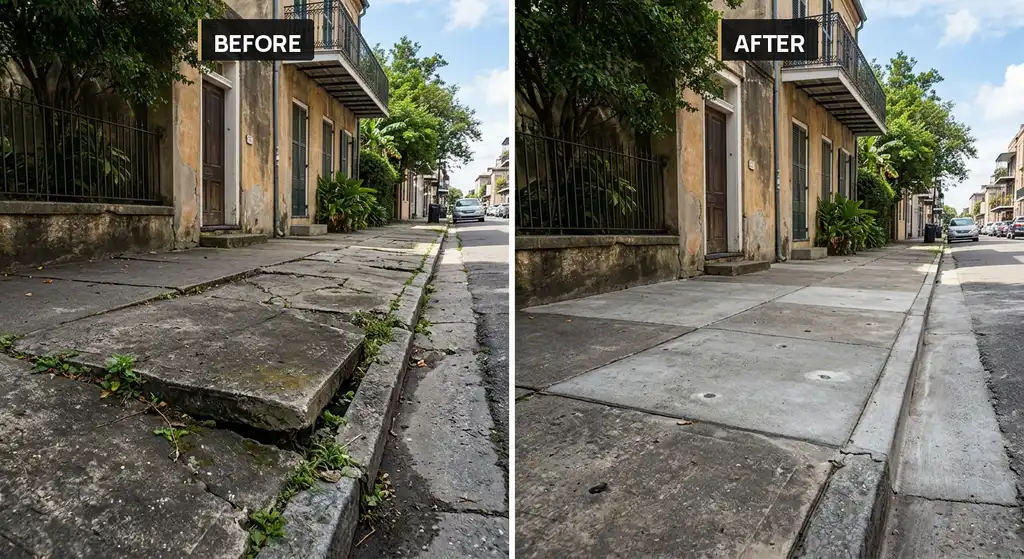
New Orleans Concrete Leveling connects businesses, HOAs, landlords and property managers with independent local contractors for sidewalk trip hazard repair in New Orleans — surveying walks, entries and parking-lot paths, then lifting sunken edges back flush with the slab beside them. It's different from homeowner sidewalk leveling: the goal is a documented, liability-driven fix across many locations, often on a schedule that keeps the property open.
The City of New Orleans states that keeping a sidewalk free from hazardous conditions is the responsibility of the residential or commercial property owner. For a commercial property, that includes the public walk out front as well as your own paths.
What happens on the first visit
A trip hazard survey produces a record as well as a quote:
- Every vertical change measured and located, ideally photographed with a ruler for your files.
- Each hazard classified against the ADA thresholds below.
- Sunk vs heaved — leveling fixes sunken edges; heaved ones need grinding or replacement.
- Public right-of-way vs private property, since City walks need a repair permit.
- A written, prioritized scope with pricing by location.
The numbers that define a trip hazard
The 2010 ADA Standards for Accessible Design (§303) set the benchmark most property managers work to: a vertical change in level up to 1/4 inch is allowed; 1/4 to 1/2 inch must be beveled at no steeper than 1:2; anything over 1/2 inch must be treated as a ramp. A sunken slab edge over half an inch fails outright.
Grinding a bevel is fast but leaves the slab low, and it can't fix a drop of an inch or more. Lifting the low slab removes the change entirely and fixes the drainage that caused it. The two are often combined: lift the sunken slabs, grind the few heaved by roots. Is a sunken slab dangerous? covers the liability side.
Working around an open business
Polyurethane foam is the usual choice: holes about 5/8 inch wide, cured in about 15 minutes, so a walk can reopen within the hour. Work can be scheduled early, late or in sections to keep an entry open. For walks in the public right-of-way, the City's Sidewalk Repair Permit applies and needs the contractor's license information.
Pricing multi-location work
Trip hazard work is priced per location or per lift from the survey, because a scattered set of lips costs differently from one long run. HomeGuide's per-square-foot references — $4–$9 for mudjacking, $8–$25 for foam — apply to the slab area lifted. Bundling every location into one mobilization avoids paying the $300–$700 minimum several times. For bigger commercial scopes, see commercial concrete leveling and Louisiana's licensing thresholds.
What a proper trip hazard repair job includes
- Measured, located list of every hazard
- Each hazard classed against the ADA thresholds
- Sunk and heaved edges separated
- Permit needs flagged for public walks
- Written, prioritized scope and price
- Work scheduled around business hours
- Low slabs lifted flush, joints sealed
- Before-and-after measurements for your records
DIY patch vs cheapest operator vs proper trip hazard repair
| Factor | DIY patch or topping | Cheapest operator | Proper leveling job |
|---|---|---|---|
| Fixes the void under the slab | No | Sometimes | Yes |
| Actually raises the slab | No | Yes | Yes |
| Drop measured at every joint first | No | No | Yes |
| Method chosen for your soil | n/a | Whatever rig they own | Yes |
| Written price before drilling | n/a | Rarely | Yes |
| Holes patched, joints sealed | n/a | Holes only | Yes |
| Drainage cause addressed | No | No | Yes |
| Carries liability insurance | n/a | Ask | Ask — and verify |
| Typical life | Cracks as the slab keeps moving | Short if the cause isn’t fixed | 5–10+ years (mudjacking) |
| Typical cost, 150 sq ft patio | Materials only | Lowest bid | $600–$1,400 slurry · ~$1,200–$3,750 foam |
Proper-job cost and life from HomeGuide's mudjacking cost data; foam range calculated at HomeGuide's $8–$25/sq ft. Resurfacers and self-leveling toppings cover the surface; they don't lift the slab.