
Last updated:
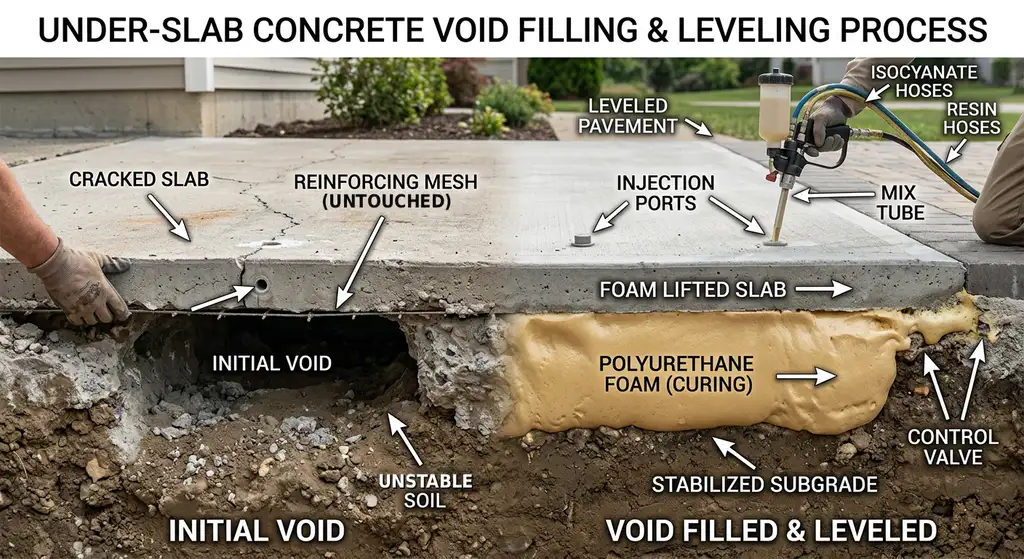
New Orleans Concrete Leveling connects property owners with independent local contractors for soil stabilization in New Orleans — injecting expanding polyurethane into soft, loose or washed-out soil beneath a slab to densify it and fill voids before, or instead of, lifting the concrete. It's the step that addresses the ground rather than just the slab.
New Orleans needs it more than most places. Much of the south shore sits on drained marsh and organic soil that the City of New Orleans says keeps compacting as it dries and oxidizes. A slab lifted over soft ground can go back down; stabilizing the layer under it gives the lift something firm to sit on.
What happens on the first visit
Soil stabilization is recommended after a closer look at what's under the slab:
- How far and how often the slab has dropped — repeat settling is the classic sign.
- Probe or test-hole readings of how soft the soil is and how deep.
- Water sources, since wet soil will keep softening.
- The load on the slab — foot traffic, cars, equipment.
- A written plan: stabilize only, or stabilize and lift.
How it differs from a normal lift
A standard lift puts material in the thin space right under the slab. Soil stabilization goes deeper: injection tubes are driven through the slab into the soil, and foam is injected at depth, where it expands, fills voids and compacts the surrounding soil. The slab may then be lifted with a shallow injection in the same visit.
Because foam is light and doesn't wash out once cured, it adds little load to soft ground — the reason polyurethane foam is the usual material for this work.
When it's worth adding
Consider it when a slab has already been leveled and sank again, when probing finds soft soil well below the slab, under heavily loaded slabs like garage floors and loading aprons, and around slabs over old utility trenches or backfill. For a first-time settle on a firm base, a standard lift is usually enough. Will my slab sink again? covers the causes of repeat settling.
How soil stabilization is priced
Stabilization is quoted by the volume of material and the number of injection points, after probing. It adds to the cost of a standard lift, which HomeGuide puts at $8–$25 per square foot for foam. Ask whether the quote includes a volume cap and how overruns are billed. Large commercial scopes may cross Louisiana's licensing thresholds.
What a proper soil stabilization job includes
- Probing to find soft layers and depth
- Water source identified and addressed
- Written plan: stabilize, lift, or both
- Injection points spaced for coverage
- Deep injection before any slab lift
- Slab watched so it isn't lifted early
- Holes patched and joints sealed
- Volume used recorded for your records
DIY patch vs cheapest operator vs proper soil stabilization
| Factor | DIY patch or topping | Cheapest operator | Proper leveling job |
|---|---|---|---|
| Fixes the void under the slab | No | Sometimes | Yes |
| Actually raises the slab | No | Yes | Yes |
| Drop measured at every joint first | No | No | Yes |
| Method chosen for your soil | n/a | Whatever rig they own | Yes |
| Written price before drilling | n/a | Rarely | Yes |
| Holes patched, joints sealed | n/a | Holes only | Yes |
| Drainage cause addressed | No | No | Yes |
| Carries liability insurance | n/a | Ask | Ask — and verify |
| Typical life | Cracks as the slab keeps moving | Short if the cause isn’t fixed | 5–10+ years (mudjacking) |
| Typical cost, 150 sq ft patio | Materials only | Lowest bid | $600–$1,400 slurry · ~$1,200–$3,750 foam |
Proper-job cost and life from HomeGuide's mudjacking cost data; foam range calculated at HomeGuide's $8–$25/sq ft. Resurfacers and self-leveling toppings cover the surface; they don't lift the slab.